
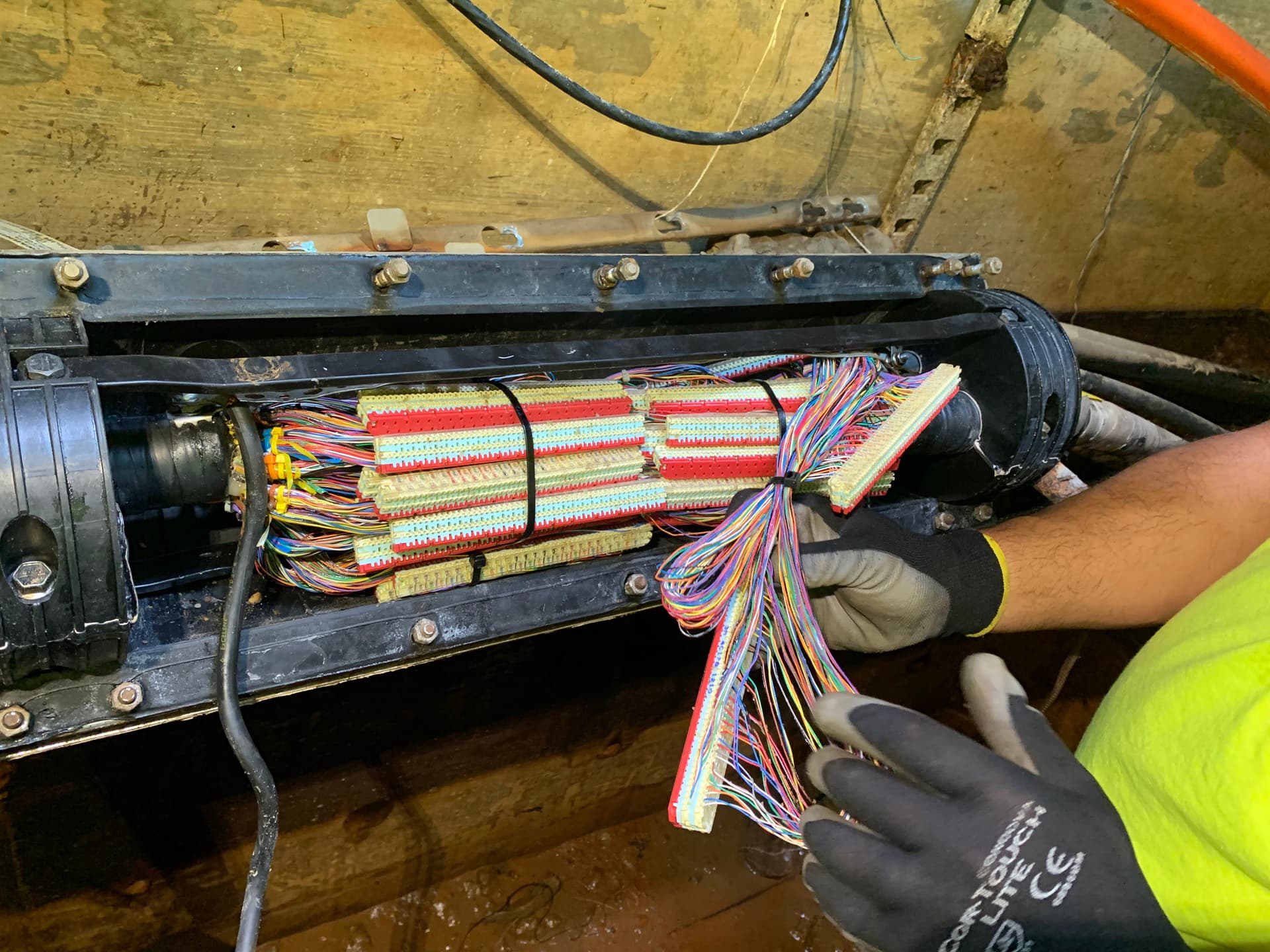
Fiber and copper cable repair both require trained splicers, but the tools, techniques, and failure modes are completely different. Sending a fiber splicer to repair a copper cable - or vice versa - wastes time and risks making the damage worse. Here is what you need to know before you call for help.
The Core Difference: Light vs. Electricity
Fiber optic cables transmit data as pulses of light through glass strands with cores smaller than a human hair. Copper cables transmit electrical signals through twisted pairs of copper conductors. The physics are different, the failure modes are different, and the repair techniques are completely different.
Mixing up the two is common among project owners who are not in the industry. When you call for repair help, knowing which type of cable is damaged will get you the right crew faster and avoid dispatch of a technician who cannot do the work.
Fiber Optic Cable Repair
Fiber repair requires a fusion splicer, fiber cleaver, OTDR, and splice closure hardware. The damaged section is located using the OTDR, the cable is cut back on both sides of the damage to expose clean fiber, the individual strands are fusion-spliced together, and the joint is sealed in an appropriate closure for the environment (buried, aerial, or in-building).
Fiber repair is precise, clean work. The fiber ends must be cleaved flat and free of contamination - a single fingerprint or dust particle on a fiber end will cause elevated splice loss. Experienced fiber splicers work in a controlled environment even in the field, using a splice trailer or clean workspace inside a service vehicle.
Copper Cable Repair
Copper telephone and data cable repair uses a different set of tools: wire maps, TDR (Time Domain Reflectometer for copper), punch-down tools, and cable-specific splice connectors. Buried copper cable is commonly repaired using UY or B-wire connectors with gel fill, or direct-burial splice cases with moisture-blocking compound.
Copper repair is faster per-pair than fiber per-strand but scales differently - a 100-pair copper cable has 200 individual conductors to splice, each requiring an individual connection. High-pair-count copper repairs are labor-intensive and time-consuming.
Copper splicers also test differently - pair-by-pair continuity, resistance, and capacitance testing rather than optical power loss. TDR testing locates faults by sending a pulse down the cable and measuring the reflection time from a break or short.
Which Type Do You Have?
If you are not sure what type of cable is damaged, look at the cable jacket. Fiber optic cables are typically labeled with "FIBER OPTIC," "SM" (single-mode), or "MM" (multi-mode) and are usually smaller in diameter. Copper telephone cable is heavier, and the jacket often says "Telephone Cable" or a pair count like "25 PR."
If the cable feeds data circuits or internet service, it is more likely fiber. If it feeds telephone service, DSL, or analog systems, it may be copper. If you genuinely cannot tell, describe what you are looking at to the contractor before they dispatch.