
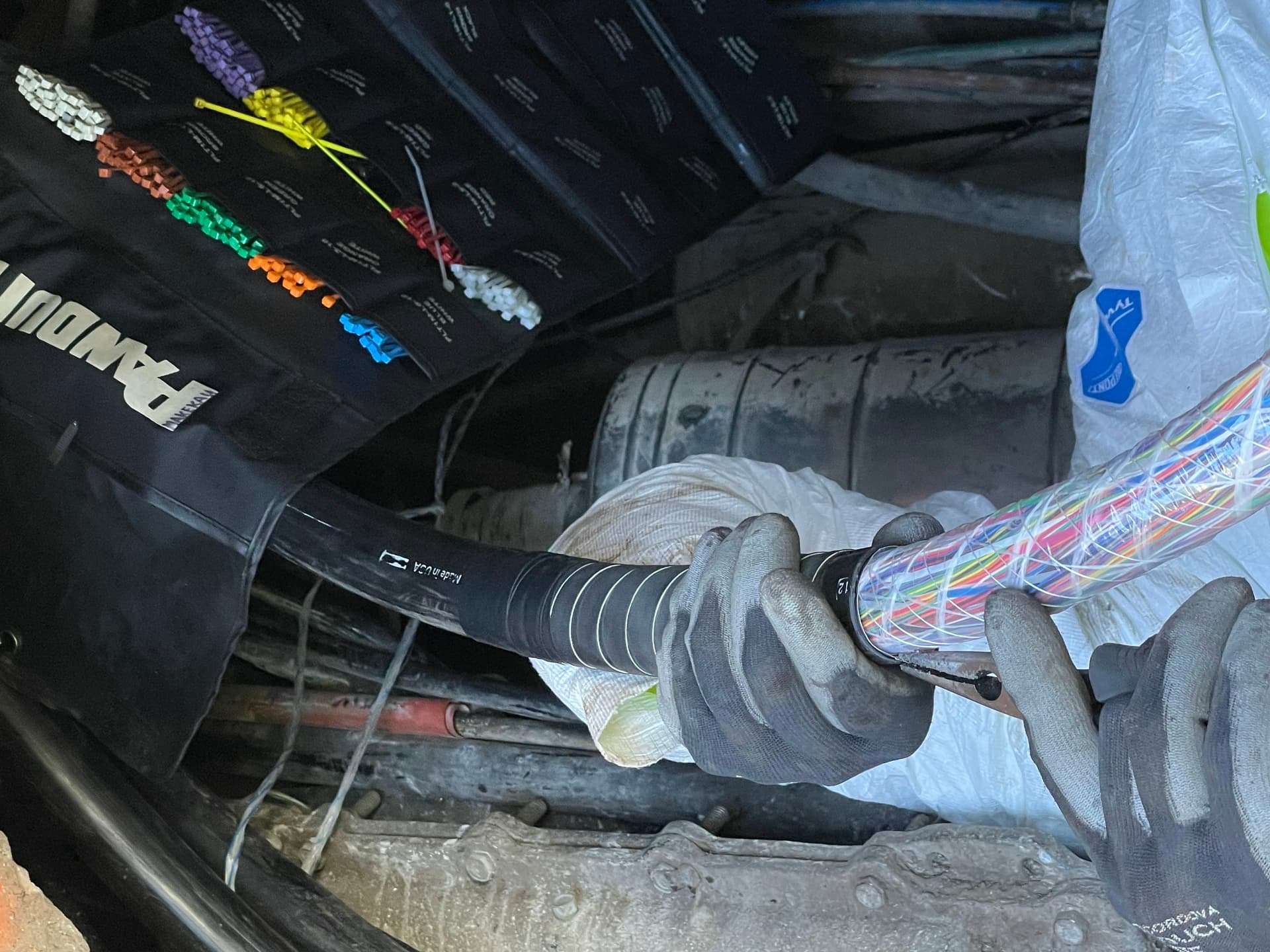
Outside plant (OSP) cable splicing is the work done on telecommunications cables that run through conduit, direct-buried, or aerial strand outside of buildings. It is physically demanding, weather-dependent, and technically demanding - and it is the core of what most professional cable splicers do.
OSP Environments
Outside plant infrastructure runs in three basic configurations, each with distinct splicing requirements:
- AerialCable suspended from a messenger strand between utility poles. Splicing is done from a bucket truck or a ladder. Exposure to weather, wind, and traffic are constant concerns. Aerial splice closures must be weatherproof and UV-resistant.
- Underground / ConduitCable pulled through buried conduit and accessed via manholes and handholes. Vault entry often requires confined space entry procedures. Conduit routes in urban areas can be complex with multiple cables in the same path.
- Direct BuriedCable buried directly in the ground without conduit, accessed by excavation. Common in residential and rural areas. Damage often comes from landscaping or excavation. Direct-buried splice closures must handle ground moisture and soil pressure.
Tools of the OSP Splicer
A professional OSP splicer carries a significant equipment load. Beyond the fusion splicer and OTDR, an experienced crew travels with: fiber cleavers, fiber holders and prep tools, splice trays and closure hardware, cable cutting and jacket stripping tools, a laptop or tablet for trace analysis, and a service vehicle configured as a mobile workspace.
For copper OSP work, the kit includes a TDR, pair-gain test set, cable locator, tone generator, and a selection of splice connectors for both standard and gel-filled applications. High-pair-count copper splicers often work in pairs - one splicing, one running wire from the cable count.
Safety in OSP Work
OSP splicing involves real hazards that desk-based workers do not encounter. Traffic control is required for any work in or adjacent to a roadway. Aerial work from a bucket truck requires a qualified operator and awareness of overhead power lines - accidental contact with an energized line is a fatal hazard. Underground vault entry requires confined space entry procedures when the space meets OSHA's permit-required criteria.
Experienced OSP contractors maintain OSHA 10 or OSHA 30 certifications, confined space entry training, and first aid/CPR. When hiring a contractor for OSP work, ask about their safety program and whether they carry the appropriate insurance for the work environment.
OSP Splice Closure Selection
The choice of splice closure depends on environment and cable type. Dome closures are the standard for buried and underground applications - they provide good moisture protection and accommodate a range of cable diameters. Aerial splice cases are designed for strand lashing and must handle UV, temperature cycling, and wind vibration. In-line closures are used where cables enter buildings or transition from outdoor to indoor-rated cable. Matching the closure type to the environment is as important as the splice quality inside it.