
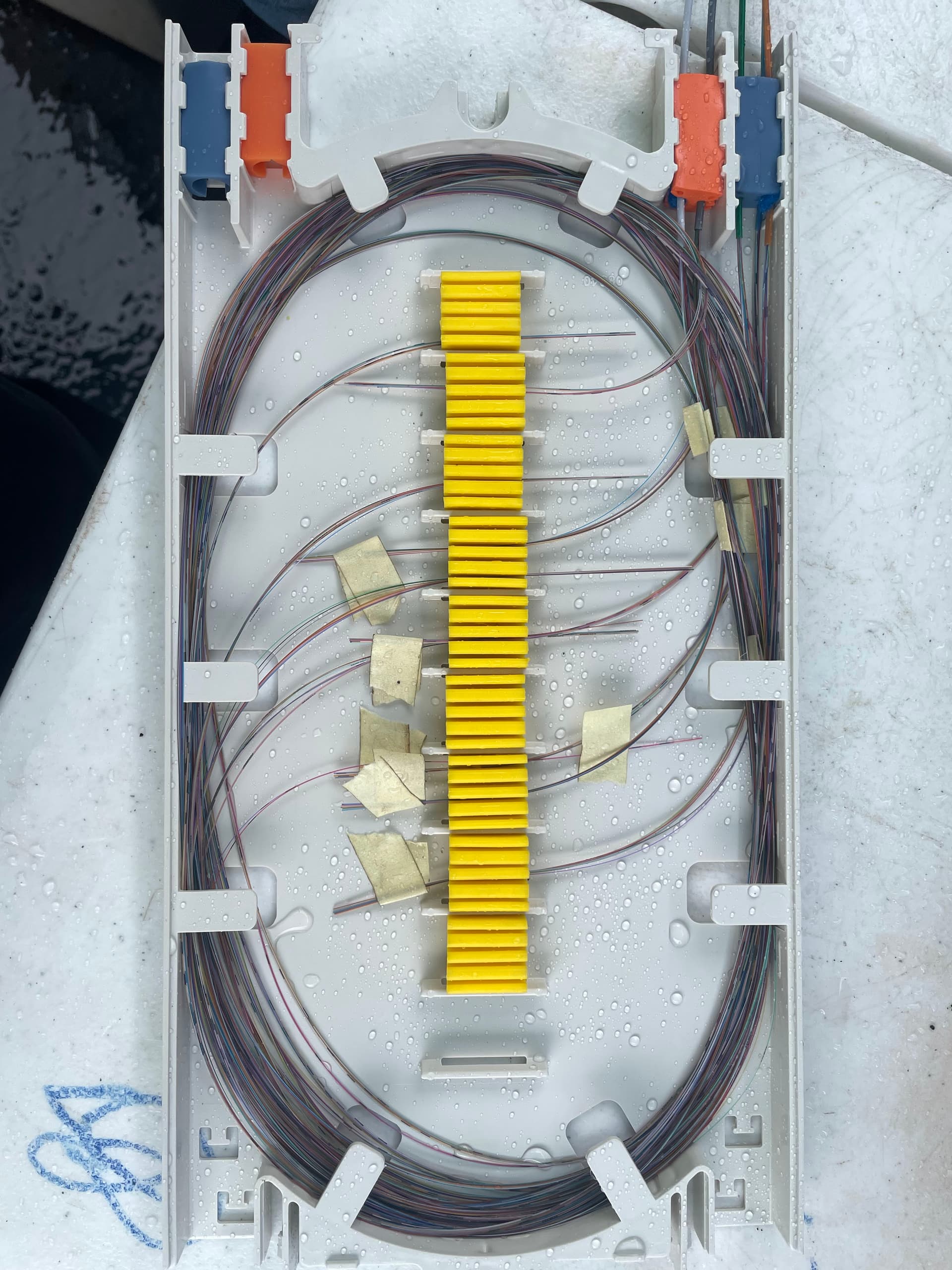
Fiber optic splicing costs vary widely depending on project size, location, fiber type, and site conditions. For most commercial projects, expect to pay $50–$150 per fusion splice point - but that number can swing in either direction based on the factors below.
Fusion Splicing Cost Per Splice: 2025 Benchmarks
The "per splice" rate is the most common pricing unit contractors quote for fiber work. It covers the actual splicing labor at each splice point and generally includes OTDR verification of each joint. It does not typically include mobilization, material (closures, trays), or project management.
| Scenario | Cost Range Per Splice | Notes |
|---|---|---|
| Standard single-mode, accessible site | $50–$85 | Conduit or aerial, good access |
| Underground vault work | $80–$130 | Confined space, extra setup time |
| Ribbon fiber (mass fusion) | $15–$40 per ribbon | 12-fiber ribbon - fast but specialized |
| Emergency / after-hours | $150–$300+ | Overtime rates, rapid mobilization |
| Remote / rural location | $100–$200+ | Travel premium, lodging may apply |
| OTDR acceptance testing only | $75–$150/hr | Per hour, not per splice |
What Drives Fiber Splicing Cost
1. Fiber Count
A 12-fiber cable has 12 splice points per closure. A 144-fiber cable has 144. Large fiber counts on a single project drive the per-splice rate down through volume pricing - a contractor who quotes $100/splice for a 24-fiber job may quote $55/splice for a 288-fiber build. Always ask about volume pricing on large projects.
2. Access and Site Conditions
Aerial splicing from a bucket truck in a clear suburban street is faster and cheaper than underground vault work in a busy downtown intersection requiring traffic control. Confined space entry (vaults classified as permit-required) adds safety overhead, equipment requirements, and often a second crew member as standby - all of which increase cost.
3. Fiber Type
Standard OS2 single-mode fiber (the most common OSP plant) is straightforward. Ribbon fiber requires a mass fusion splicer - not all contractors own one. Bend-insensitive fiber (like Corning ClearCurve) and specialty fiber types may require different cleave settings and technique. Always confirm the contractor has experience with your specific fiber.
4. Mobilization and Travel
Most contractors charge a mobilization fee separate from the per-splice rate. This covers travel time, fuel, and setup. Typical mobilization fees run $150–$500 for local work. Rural or remote sites where the contractor must travel 2+ hours or stay overnight will add significantly to the total.
5. Materials
Splice closures, enclosures, splice trays, and fiber protection sleeves are not labor - they are materials billed separately. A single inline closure can cost $80–$300 in material depending on type and capacity. Dome closures for buried applications, wall-mount enclosures for buildings, and aerial splice cases all have different price points. Confirm whether your quote includes materials or is labor only.
6. Testing and Documentation
OTDR testing is sometimes included in the per-splice rate and sometimes billed separately at $75–$150/hour. End-to-end loss testing with a light source and power meter may be an additional line item. If you need a formal OTDR trace report for turnover documentation, confirm this is included and ask what format the traces are delivered in.
How to Get an Accurate Quote
Fiber splicing quotes are most accurate when you can provide: total fiber count, cable type and manufacturer if known, number of splice points (closures), site access conditions, and whether OTDR documentation is required for turnover. A good contractor can quote based on a cable plant drawing or a simple verbal description of the job.
For projects with fewer than 50 splice points, most contractors will quote a flat price for the whole job rather than a per-splice rate. For large builds, expect time-and-material or unit-price contracts with per-splice line items.
Red Flags in a Splicing Quote
- ⚠No mention of OTDR testing - corners are being cut.
- ⚠Quote is verbal only with no written scope - no protection if there is a dispute.
- ⚠Extremely low per-splice rate with no experience verification - quality will suffer.
- ⚠No itemization of materials vs. labor - hard to compare bids accurately.
- ⚠No warranty on splice loss - professional splicers stand behind their work.