
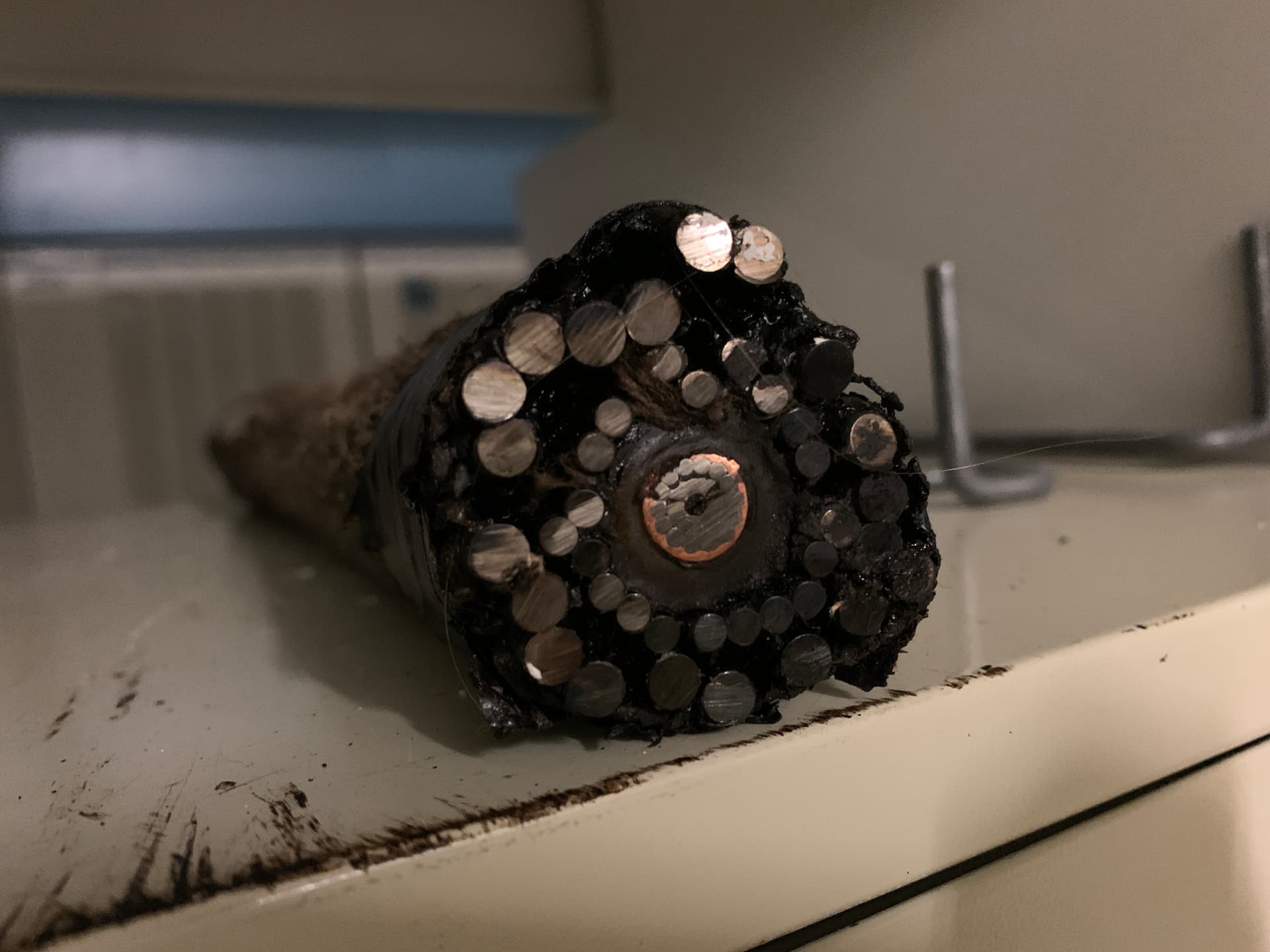
Most people know that the internet runs on fiber optic cable. Far fewer know that roughly 99% of all international internet traffic - every email, video call, and file transfer between continents - travels through a network of submarine cables laid across the ocean floor. This is what one of those cables looks like when you cut it open.
How We Got a Section of It
Working as a cable splicer in Hawaii puts you closer to submarine cable infrastructure than most people will ever get. Hawaii sits at the crossroads of multiple transpacific cable systems - the islands are both a landing point and a waystation for cables running between the US mainland, Japan, the Philippines, Guam, and beyond.
This particular section is a remnant of a decommissioned transpacific submarine cable system that once connected the continental United States to the Pacific Islands and Asia via California. When these systems are retired, sections sometimes surface - salvaged during infrastructure work or preserved as technical artifacts. What you are looking at is a genuine piece of the physical backbone of the internet.
The Cable Cross-Section: Layer by Layer
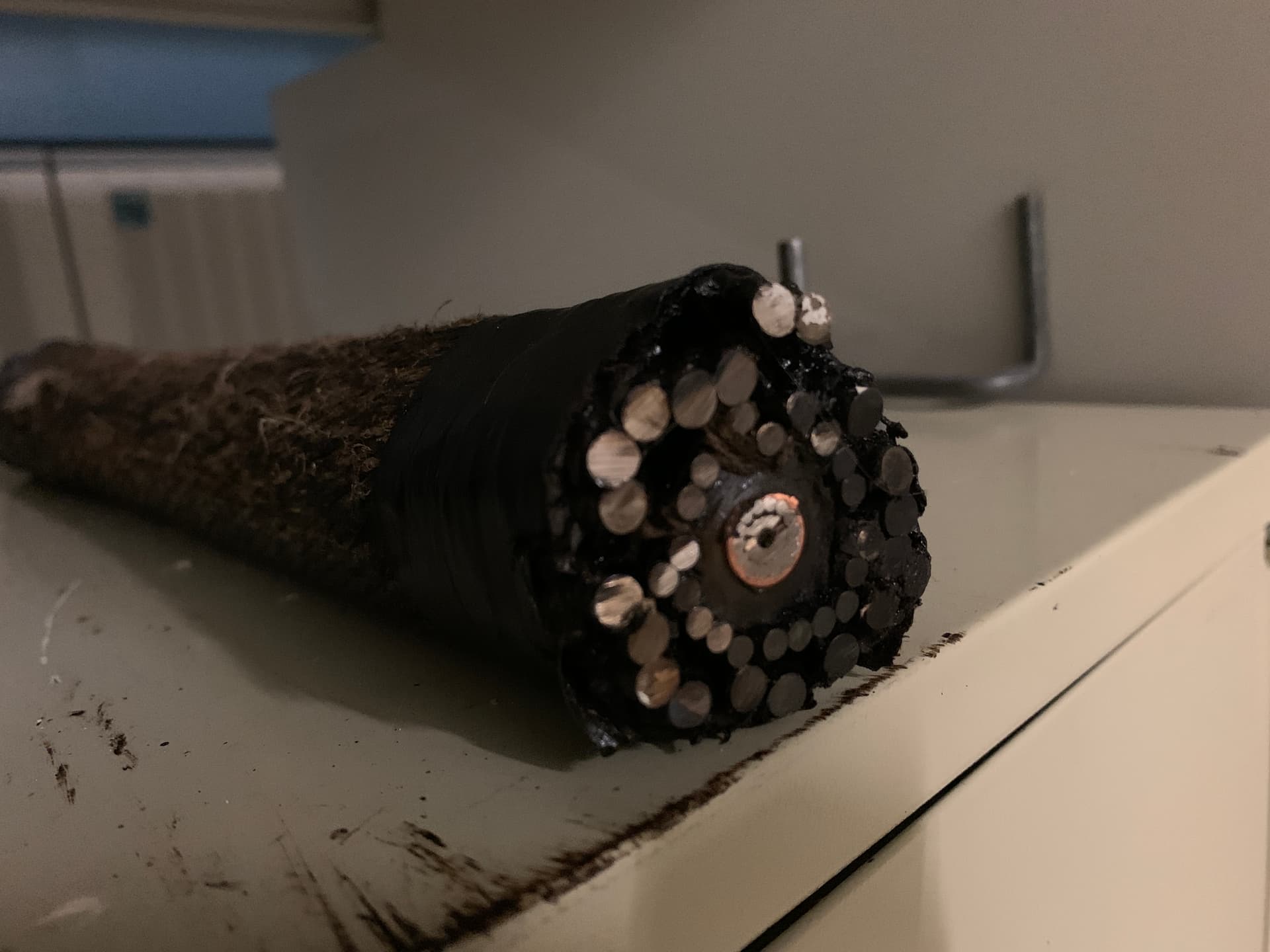
Submarine cables are engineered to survive conditions that would destroy any land-based cable within months - crushing pressure, salt water, trawling nets, ship anchors, and earthquake-driven seafloor movement. Every layer in the cross-section exists for a specific reason.
Outer Polyethylene Jacket
The outermost layer is a thick high-density polyethylene (HDPE) sheath. It provides the first line of protection against abrasion, seawater, and mechanical damage. In shallow-water sections near shore - where cable is most vulnerable to anchors and fishing gear - additional armor layers are added over this jacket.
Steel Armor Wires
The ring of steel wires visible in the cross-section is the tensile strength member of the cable. During installation, a cable-laying ship lowers miles of cable under enormous tension. The armor wires carry that load. They also provide mechanical protection against crushing and abrasion on the seafloor. Deep-water cable uses fewer armor layers than shallow nearshore cable - at 4,000 meters depth, ship anchors are not a concern.
Copper Power Conductor
The central copper tube or conductor is one of the most critical - and least-known - components of a submarine cable. Undersea fiber requires signal repeaters (amplifiers) spaced every 50–100 km along the cable route. These repeaters run on DC electrical power fed through the copper conductor from shore-based power feed equipment at the cable landing stations. A transpacific cable may carry 10,000 volts DC through this conductor to power hundreds of repeaters across the ocean floor.
Inner Insulation and Fiber Unit
Inside the copper conductor sits the actual fiber optic unit - typically a small bundle of single-mode fiber strands surrounded by a water-blocking compound and a steel or fiber-reinforced plastic strength member. Despite the massive engineering around it, the actual data-carrying glass is surprisingly thin - each fiber strand is about 125 microns in diameter, roughly the width of a human hair.
A Few Fibers Carry Everything
Here is the part that surprises most people: a modern submarine cable may contain only 8 to 16 fiber pairs (16–32 individual strands), yet carry terabits of data per second. The capacity comes not from fiber count but from dense wavelength division multiplexing (DWDM) - packing hundreds of separate light wavelengths onto a single fiber, each carrying its own data stream simultaneously.
By contrast, a land-based fiber cable serving a city neighborhood might contain 144 or 288 fiber strands - far more than a transpacific cable - but carry a fraction of the traffic because it lacks the high-end DWDM amplification equipment.
Hawaii at the Center of the Pacific Network
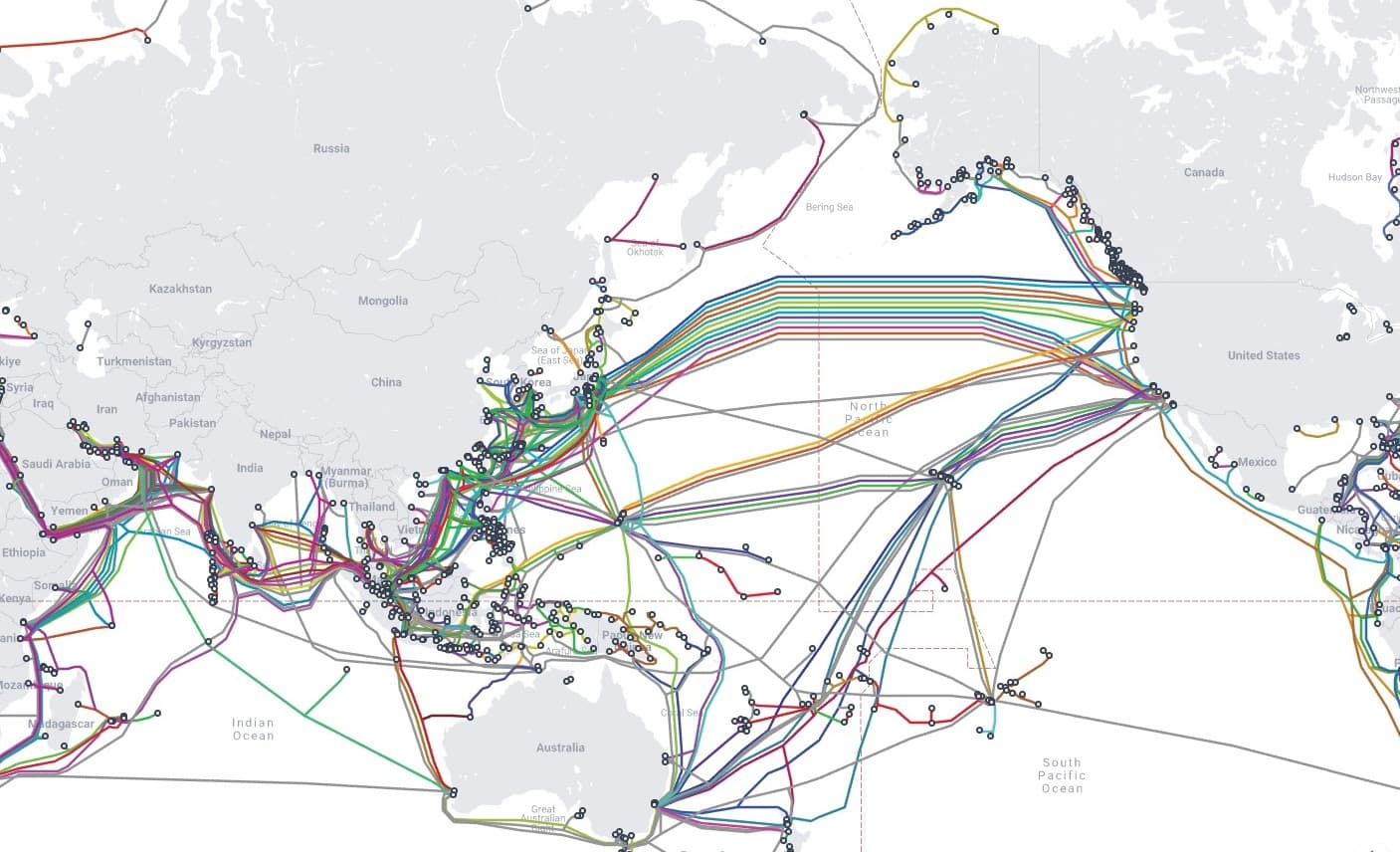
Map source: TeleGeography submarinecablemap.com
Look at the concentration of cable routes across the North Pacific on any submarine cable map and you will see why Hawaii matters. Multiple cable systems converge on the islands - some terminating there, others passing through repeater stations on their way between California and Japan, the Philippines, Guam, and Australia.
The Hawaii Island Fibre Network (HIFN) handles inter-island connectivity within the Hawaiian archipelago, linking Oahu, Maui, Hawaii Island, Kauai, Molokai, and Lanai. The new Hawaiian Islands Fiber Link (HIFL) - a $120+ million public-private project currently under construction - will replace and dramatically expand that capacity with 24 fiber pairs and a 25-year design life.
But the cables that connect Hawaii to the rest of the world are the transpacific systems - the ones that this cross-section came from. When you make a video call from Honolulu to Tokyo, your signal travels through a cable not unlike the one pictured here, sitting on the seafloor somewhere between 1,000 and 7,000 meters below the surface.
What This Has to Do with Splicing
Submarine cable splicing is one of the most specialized forms of fiber work in the industry. When a submarine cable is damaged - by a ship anchor, an earthquake, or a fishing trawler - a cable repair ship is dispatched to locate the fault using specialized OTDR equipment, grapple the cable up from the seafloor, cut out the damaged section, splice in a new segment, and lower it back down. The whole operation can take weeks and costs millions of dollars.
The splicing technique is the same fundamental process used in any fiber splice - clean, cleave, fuse, protect - but performed under unusual conditions with specialized pressure-housing closures rated for deep-sea deployment. The same physics that governs a 0.05 dB splice loss on a land-based fiber plant governs a splice 4,000 meters underwater.
For those of us who work with fiber on land every day, a physical section of retired submarine cable is a useful reminder of what the craft connects to - a global network of glass and light that makes modern communication possible.